Ask after me this time next year, and you will find me a Montanan.
August, actually, is the projected move date. Eight years after I first moved to this city, six years after A. and I first moved in together in a little carriage house on Hunter Street, two and a half years after buying our first house, we will throw the last box in the truck and head west. We are moving because A. found a job doing exactly what she wants to do, and how many of us ever get a chance like that? It would certainly be unwise to count on the opportunity arising more than once, especially in A.’s field of wildlife biology, where full-time, permanent positions with liveable salaries are few and far between. As for me, I’ll freelance, although what exactly that will entail and what sort of mix of policy/commercial work and journalism will result is anyone’s guess, and, although I’m nervous, I’m looking forward to the change.
The “far” part is hard, though. Obviously, it would have been nicer all around if A.’s dream job had turned out to be right here in Maryland. Except… I can’t say I’m sorry for the disruption. It’s a frightening thing to quit a job that you otherwise have no particular reason to leave, but even more frightening is having no particular reason to leave. Inertia is strong. Before you know it, you’ve been somewhere ten years, and maybe you won’t ever leave then. I was telling a friend that I felt bad for A.’s having to leave this house she’s put so much work and care and love into, and I said something about wishing she’d had a few more years at it. My brother, who was listening, said, “Imagine how much harder it would be to leave after five years, though.” I was immediately chilled by the prospect of all of that sameness, stretching endlessly into the future, and I knew that we’d made the right decision. I’m not inherently opposed to sameness – I love the idea of a settled existence, but only someplace I really love, and Baltimore doesn’t seem to qualify. It’s too hot and there is too much particulate pollution and also too many murders. It’s not that I’m afraid of being murdered, exactly, but it gets harder and harder to ignore the pall of misery and death over this city, where vast swaths of the population are condemned to a worse-than-third-world existence, and I actually am sort of worried about what living here has already done to my lungs.
The decision to move to Montana seems to impress some people, in the same way people are impressed by plans to climb Everest or to make a round-the-world balloon trip. Could I do that? they wonder, momentarily, before concluding that they wouldn’t want to anyway and it takes all kinds. I confess that my early reaction to the whole idea was along these lines, too, as if we’d be cutting ties to the known universe and striking out into the blank sections of the map. Here be monsters, or at least grizzly bears.
Having recently returned from a visit to the area, I can report that the cafes offer wireless internet access and most people wear shoes and store-bought clothes, so the change probably won’t be too much of a shock to our systems. The buildings are short and there is a lot of sky, however. Waiting for the light at a downtown intersection, I saw a tumbleweed roll past. While I walked the streets I found my shoulders climbing up around my ears. I had the pronounced sensation of being a tiny, carbon-based life form clinging to a rock hurtling through space, continuing to exist only at the pleasure of a capricious and indifferent nature. But maybe this will help keep me humble.
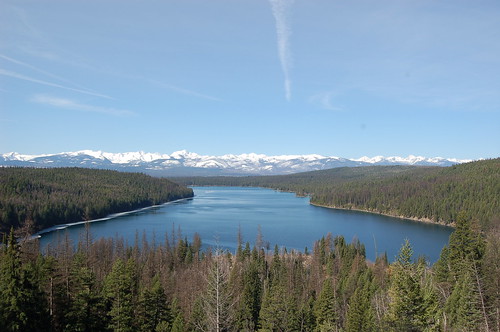
While I was visiting, A. and I rented a cabin in the “town” of Conden, near Seely Lake in the Swan Valley, about two hours’ drive from Missoula. The cabin was on the grounds of a general store, and we checked in at the front counter, A. signing the credit card slip while I read the notice on the shelf behind the counter: “Rifle ammo, 18 and up; handgun ammo, must be 21.” One morning, we drove for 20 minutes down a well-kept gravel road and then made a one-hour hike along the shore of sapphire-blue Holland Lake to the waterfall that feeds it. From the trail, about 30 feet back from and 20 feet above the lake, I could clearly see logs and rocks under the water, to a depth of perhaps 10 feet. Majestic ponderosa pines loomed overhead, flexing and swaying almost imperceptibly in the wind, like underwater grasses ruffled by a gentle current. The horizon was edged with the blue and white peaks of the Mission Mountains. And all of this was simply too much to process. I couldn’t make myself believe it was real, as opposed to a painting in a gallery, which is where I’m used to seeing full-fledged, glorious nature, which is to say that I’m not really used to it at all.
Later, looking at the map for a town we could drive to from the cabin, we picked Polson, which looked close, before noticing that there weren’t any direct roads because the green smear between us and Polson was the Mission Mountains. As obstacles to human movement (or at least road building), the mountains suddenly seemed real enough, and I was startled to realize how startled I was at being forced to think about geography in this way, there being few remaining undefeated mountain ranges in the mid-Atlantic. We drove north to Big Fork instead, near Flathead Lake, one of the more settled, touristy areas in rural Montana, and even the dirt looked clean, not to mention the crystal clear lakes that we got used to seeing. I think I’ll have to spend some time in that landscape before it starts to feel real. Maybe it never will, or maybe I’ll never stop noticing it and marveling at it. I suppose there are worse things than constantly having to remind yourself that you are not in fact living in a painting.
As opposed to an episode of The Wire, David Simon’s brilliant depiction of Baltimore as an epitome of this country’s failed “war” on drugs. I know that I face nothing so terrible as what Simon’s characters – and so many of this city’s residents – face every day, except possibly being casually gunned down by some urchin with a $25 handgun and no plan for his life beyond ignoring it for the next six hours with a vial of ready rock and some malt liquor. Again, I’m not possessed by a fear of scenarios like this one, but awareness of their likelihood – awareness that, if it isn’t me, it could be a friend or a neighbor or someone I work with, and why should it have to be anyone at all – is part of the texture of life in this city, a texture further roughened by a school system that is essentially a crime against humanity, the shocking level of cronyism and machine tendencies in local politics, high homelessness (witness the tent-city refugee camp 1,000 yards from city hall), and the list goes on. At other points in my life, I wouldn’t have been talking about “ignoring” this stuff at all, as opposed to fixing it. The question is, how? My full-time job is devoted to mopping up one tiny droplet in the flood of horrors lapping at this city’s throat, but instead of giving me hope or making me feel better, my experiences make me wonder if we can ever hope to fix anything at all. Baltimore has come to represent for me human society gone utterly wrong. I’m hoping that perhaps living somewhere that is closer to being a functioning, healthy community will restore a little of my faith in humanity and in what we can manage if we all work together. I don’t really want to “ignore” Baltimore and what it represents: the failures of American policies and governance and also of our basic human responsibility to the weakest among us. In fact, I’m hoping that, with some distance, I’ll be able to think a little more clearly about these things. Certainly the strength of my desire to leave the city is yet another lesson for me in how truly awful it must be to grow up poor here, with a million more reasons to want to leave but even less chance of ever doing so.
And who knows? The city will probably be harder to shake than I expect, plus the plan now is to rent out our house, not sell it, so we’ll be connected (and we’ll still be paying our taxes). It will probably be easier to leave Baltimore than to forget it, but right now, I’m itching to see the place in my rearview mirror. When it’s time for leaving a place, my natural inclination is to get on with it. A giddiness comes over me at the thought of that moment of sundering, and the open road always looks like freedom for at least a minute or two.